
Resume Optimization: What Recruiters See in 7 Seconds (And What Gets You Ignored)
Resume optimization starts with understanding how recruiters actually scan your resume. The 7-second window, ATS filtering, and how to close the gap.
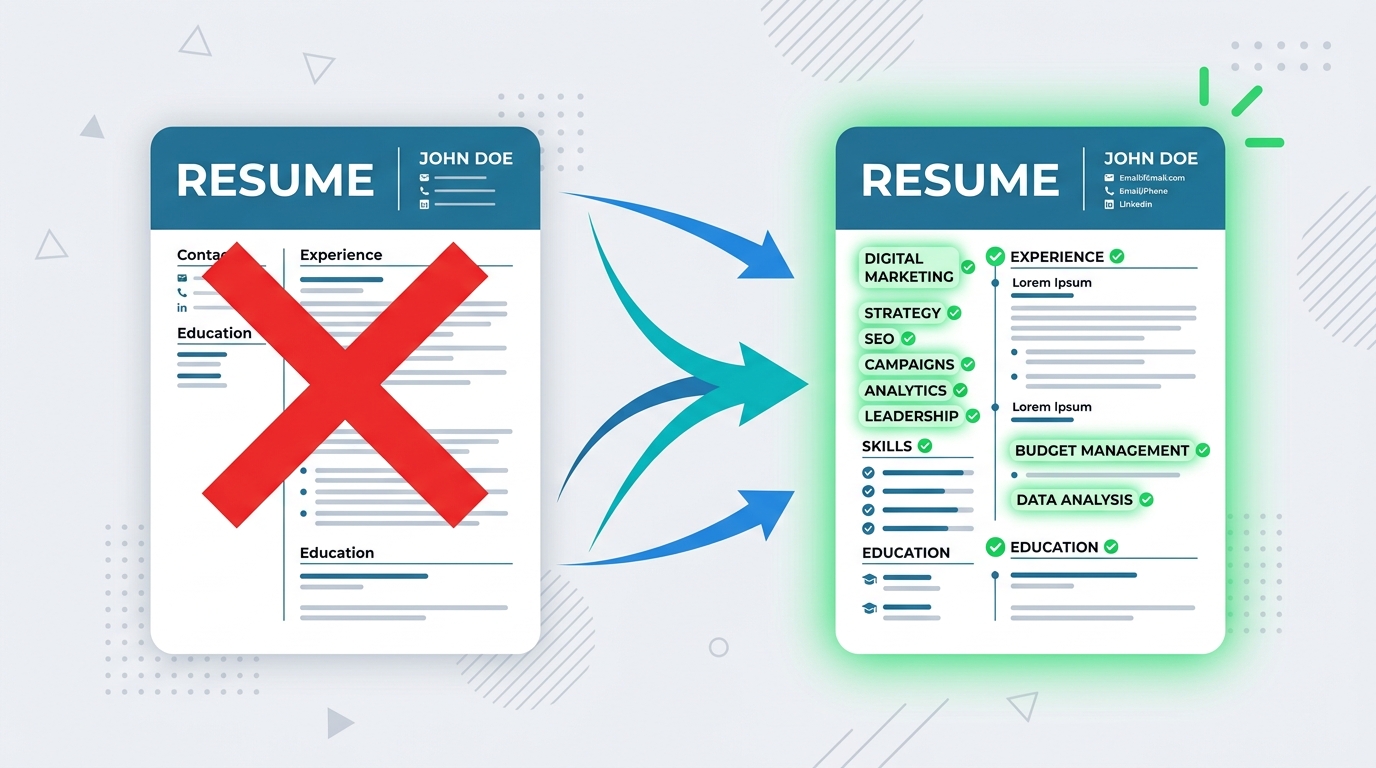
Resume optimization is the process of restructuring your resume to match what recruiters and ATS systems actually look for — not what you think makes a good resume. Most job seekers write their resume once, treat it like a personal achievement record, and send the same version to every job. Recruiters spend 7 seconds scanning it. Here's how to close that gap.
You applied to 80 jobs last month. Your experience is solid — five years as a Marketing Manager, real results, strong brands on your resume. But you've gotten two generic rejections and 78 non-responses. You start wondering if something is broken on LinkedIn's end.
Nothing is broken. The problem is that you wrote your resume for yourself, and nobody else reads it the way you do.
Your Resume Means Something Different to You Than It Does to a Recruiter
Here's a question most job seekers never consider: when was the last time you read someone else's resume?
Probably never. But a recruiter reads 50-100 per day. For a single Senior Product Manager opening at a mid-size tech company, a recruiter might receive 400 applications in the first week. They don't have 10 minutes per resume. Research from TheLadders found they spend an average of 7.4 seconds on an initial scan.
In those 7 seconds, they're not appreciating your career narrative. They're looking for four things:
- Current title — does it roughly match the role?
- Current company — do I recognize it?
- Keywords — do I see the skills we need?
- Tenure — any obvious red flags?
If those four don't click, they move on. Your carefully worded third bullet under your 2019 role? They never got there.
The Gap Between How You Write It and How They Read It
The issue isn't that you care about your resume too much. It's that there's a fundamental mismatch between how you write your resume and how recruiters read it.
When you write your own resume, you naturally organize it around your career arc — what you did, in the order you did it, with the context that makes each role meaningful to you. That makes perfect sense from your perspective.
But a recruiter scanning for a Data Engineer doesn't care that you also did front-end development, managed a team of interns, and organized the company hackathon. They care about pipeline architecture, SQL performance tuning, and Spark. Everything else is noise that pushes the relevant stuff further down the page — past where a 7-second scan will ever reach.
The fix isn't about caring less about your resume. It's about understanding who's reading it and what they need to see.
What Happens Before a Human Even Sees Your Resume
Before a recruiter scans your resume, an Applicant Tracking System (ATS) has already scored it. According to data from Jobscan, 75% of resumes are rejected by ATS before a human ever sees them. ATS software parses your resume into structured data — name, titles, companies, skills, dates — and matches it against the job description's requirements.
If the job posting asks for "stakeholder management" and your resume says "worked with cross-functional teams," you might lose that match. Same experience, different language. The ATS doesn't interpret — it matches.
Common ways resumes get filtered out by ATS:
- Missing keywords from the job description
- Non-standard section headings (e.g., "My Journey" instead of "Experience")
- Tables, columns, or graphics the parser can't read
- File format issues — some ATS struggle with heavily designed PDFs
You can check your ATS score for free before submitting to see exactly where your resume falls short. Most people are surprised by what they find.
How AI Changes the Math on Resume Tailoring
Here's the core problem: effective resume optimization means tailoring your resume for each role. But doing that manually takes 20-30 minutes per application. When you're applying to 10+ jobs a week, that's an entire workday just reformatting resumes.
This is where most people give up and send the same generic version everywhere. Understandable — but it's the single biggest reason for low callback rates.
AI tools like CVJet change the equation entirely. Paste a job description, and it restructures your resume to match — same experience, same facts, but reframed in the language the ATS and recruiter expect. What took 25 minutes now takes seconds.
The point isn't to fake anything. It's to present what you've actually done in the exact language this specific role is looking for. That's not gaming the system — that's how communication works.
The Strategic Approach: Think Like a Recruiter
The applicants who consistently land interviews don't have better experience than you. They present their experience better — for each specific role.
Start With the Job Description, Not Your Resume
Read the job description three times. Highlight the must-have skills, the preferred qualifications, and the exact language they use. That language is what the ATS is matching against, and what the recruiter's eye is trained to find.
Mirror, Don't Lie
If they want "budget management" and you handled a $2M annual budget, use the phrase "budget management" — not "financial oversight" or "resource allocation." Same experience, but now the keyword matches. This isn't gaming the system — it's speaking the recruiter's language.
One Resume Per Role Type
If you're applying to Product Manager and UX Research roles, you need two different resumes. Not slightly tweaked — structurally different. Different summaries, different bullet emphasis, different skills ordering. A Product Manager resume leads with roadmap ownership and stakeholder alignment. A UX Research resume leads with research methodology and user insights.
Cut What Doesn't Serve This Application
Recruiters reward clarity, not thoroughness. That six-line paragraph about your 2018 project? Make it one punchy bullet or cut it entirely. Older roles (5+ years back) get 2-3 bullets max. Your most recent role gets the most space because that's what recruiters weight most heavily.
What Effective Resume Optimization Actually Looks Like
Here's a concrete before/after for a Marketing Manager applying to a role that emphasizes "data-driven campaign strategy":
| Before (generic) | After (optimized for this role) |
|---|---|
| "Managed digital marketing campaigns across multiple channels" | "Led data-driven campaign strategy across paid search, social, and email, using A/B testing to improve conversion rates by 23%" |
| Skills: Marketing, Social Media, Analytics | Skills: Campaign Strategy, Marketing Analytics, A/B Testing, Google Analytics, Paid Media |
| Summary: "Experienced marketing professional..." | Summary: "Data-driven Marketing Manager with 5 years optimizing campaign performance..." |
Same person. Same experience. But the second version speaks the recruiter's language for this specific role.
The job seekers who get interviews aren't always the most qualified. They're the ones whose resumes make it immediately obvious they're qualified. There's a real difference.
FAQ
Q: What do recruiters look for in a resume? A: In the initial 7-second scan: current title, company name, relevant keywords, and tenure. They're pattern-matching against the job description, not reading your full career story. If the top third of your resume doesn't signal a match, they rarely scroll further.
Q: Should I tailor my resume for every job? A: Yes — at minimum, adjust your summary, skills section, and top bullets to match the job description's language. You don't need to rewrite from scratch each time, but the version you send should clearly match the role you're applying for.
Q: How long do recruiters look at resumes? A: Research consistently shows 6-7 seconds for an initial scan. They decide whether to read further based on your current title, company, and whether they spot the right keywords immediately. That's why resume optimization focuses on the top third of the page.
Q: How does ATS screening work? A: ATS software parses your resume into structured data and scores it against the job description's requirements. It matches keywords, job titles, skills, and sometimes years of experience. Resumes that score below a threshold never reach the recruiter. According to Jobscan, 75% of resumes are filtered out at this stage.
Q: Can AI help with resume optimization? A: Yes — specifically tools that analyze the job description and restructure your real experience to match. The key is that AI should optimize how your experience is presented, not fabricate experience you don't have.
This Is Entirely Fixable
Most roles get 500+ applicants. The recruiter spending 7 seconds on your resume isn't being lazy — they're being efficient. Your job is to make their job easy: show them, in the first few lines, that you're exactly what they're looking for.
The good news: this is a solvable problem. A targeted resume takes seconds with the right tool — and the difference in callback rates is real. Different roles need different versions. Once you start treating your resume as a living document that adapts to each opportunity instead of a fixed record, the responses start coming.
Ready to see how recruiters actually see your resume? Upload yours and get an instant ATS score with specific fixes — free, no sign-up. Check my resume →
Free ATS check
How do ATS rank your resume?
Drop it here and find out — the free scan shows exactly what the parser sees.
Drop your resume here
PDF or DOCX · 60 seconds · no sign-up

Founder of CVJet. Previously at Spotify, The New York Times, and Anchor FM. 14+ years building products used by millions.
Ready to build a better resume?
CVJet uses AI to tailor your resume for every job application. Upload once, generate unlimited tailored versions.
Try CVJet FreeRelated Articles
Laid Off? Here's Your Week-by-Week Guide to Getting Hired Again
Just got laid off and wondering what to do? This actionable guide covers your first 48 hours through month one — resume fixes, job search strategy, and more.
How to Explain Gaps in Your Resume (Without Killing Your Chances)
Learn how to explain gaps in your resume honestly and confidently. Exact scripts, phrasing tips, and strategies for every situation.
How to Write a Career Change Resume That Actually Gets Interviews
Switching careers? Learn how to reframe your experience, highlight transferable skills, and write a career change resume that gets callbacks.