
15 Resume Writing Tips That Actually Get Interviews
Proven resume writing tips that get real callbacks. 15 specific, actionable strategies to make your resume stand out and land more interviews.
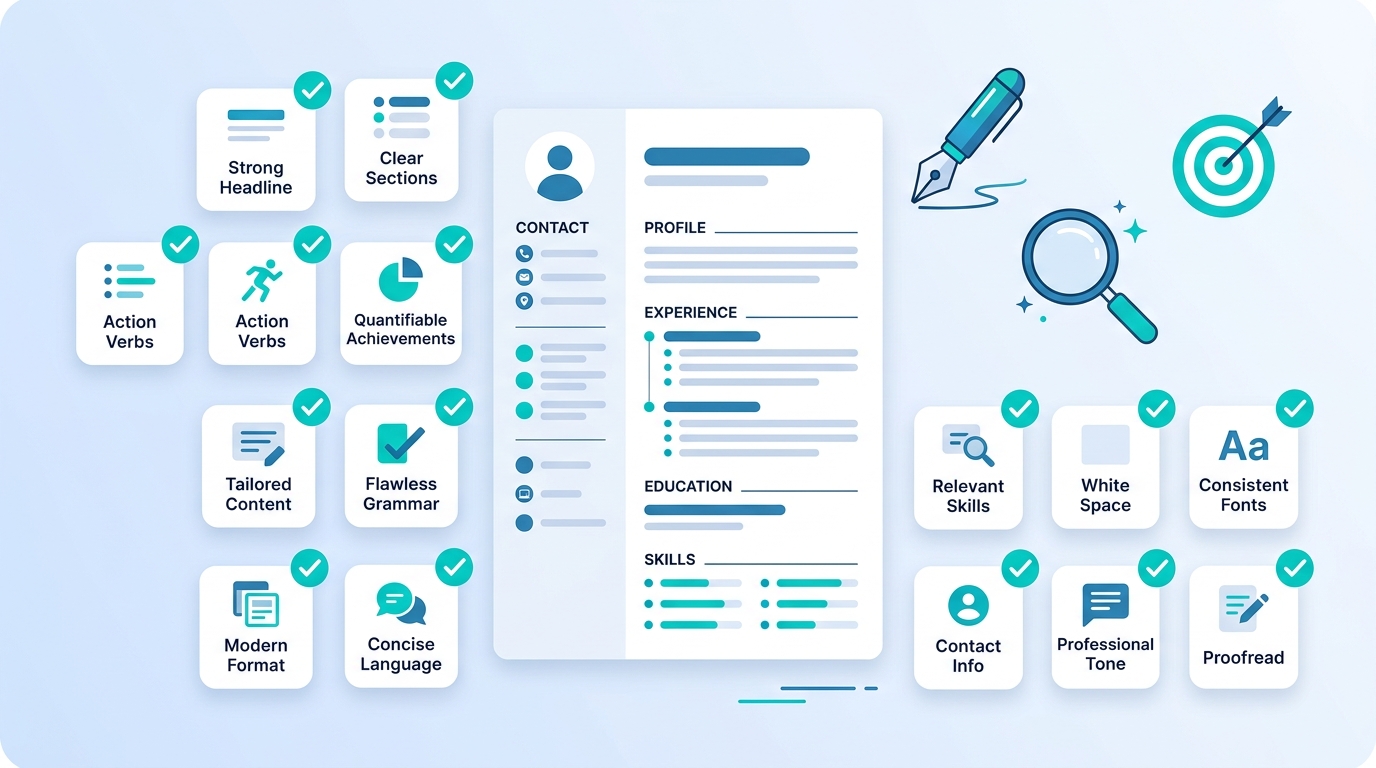
The most effective resume writing tips focus on quantified achievements, keyword alignment with the job description, and clear formatting that passes ATS screening. A strong resume is not a list of responsibilities — it is a targeted document that shows measurable impact. These 15 tips are the ones that consistently turn ignored applications into interview requests.
You rewrote your resume last weekend. Swapped some bullet points, updated your job title, sent it to 30 openings. Still nothing.
The problem isn't your experience. It's how you're presenting it. Most resumes read like job descriptions — a flat list of responsibilities that tells a hiring manager nothing about what you actually accomplished.
These 15 resume writing tips are the ones that consistently turn ignored applications into interview requests. No fluff, no filler — just what works.
1. Lead With Impact, Not Responsibilities
This is the single biggest mistake on most resumes. Listing what you were supposed to do tells the reader nothing.
Weak: "Responsible for managing social media accounts" Strong: "Grew Instagram following from 2K to 45K in 8 months, driving 30% of new customer signups"
Every bullet point should answer one question: what changed because you were there?
2. Quantify Everything You Can
Numbers are the fastest way to build credibility. Hiring managers skim — and numbers stop the eye.
Revenue generated. Costs reduced. Time saved. People managed. Customer satisfaction improved. Even rough estimates beat vague descriptions. "Managed a large team" means nothing. "Led a cross-functional team of 12 across 3 departments" paints a picture.
If you genuinely can't quantify something, at least specify scope: how many clients, projects, or systems were involved.
3. Use Strong Action Verbs
Starting every bullet with "Responsible for" or "Helped with" drains the energy out of your accomplishments. Strong verbs signal ownership and initiative.
Use words like: built, launched, redesigned, negotiated, automated, spearheaded, streamlined, increased, reduced, delivered, transformed.
Avoid: assisted, helped, participated in, was responsible for, worked on. These make you sound like a bystander, not a contributor.
4. Tailor Your Resume for Each Job
Sending the same resume to every opening is the most common reason good candidates get overlooked. Every job description emphasizes different skills, and your resume needs to reflect that.
Read the posting carefully. Identify the top 5 skills and qualifications they mention, then make sure your resume highlights experience in exactly those areas. Rearrange bullet points so the most relevant ones come first.
Yes, this takes time. Tools like CVJet can speed this up significantly — paste in the job description and it generates a tailored version of your resume in seconds, matching your experience to what the role actually requires.
5. Keep It to 1–2 Pages
One page if you have under 10 years of experience. Two pages if you have more. That's it.
No hiring manager wants to read a three-page resume. Cut anything older than 10–15 years unless it's directly relevant. Remove that college internship from 2011. Kill the "References available upon request" line — everyone knows.
6. Format for ATS First, Humans Second
Over 75% of large companies use Applicant Tracking Systems to screen resumes before a human ever sees them. If your formatting confuses the parser, you're out before you started.
The rules are simple: single-column layout, standard fonts (Arial, Calibri, Garamond), no tables or text boxes, no images or icons, standard section headers (Work Experience, Education, Skills). Use a text-based PDF or .docx.
For a deeper walkthrough, check out our complete ATS-friendly resume guide.
7. Mirror Keywords From the Job Description
ATS software scans for specific keywords from the job posting. If the description says "project management" and your resume says "overseeing initiatives," the system may not make the connection.
Pull exact phrases from the job description and weave them naturally into your experience section. Don't keyword-stuff — but do make sure the language matches. If they say "cross-functional collaboration," use that phrase, not a creative synonym.
CVJet handles this automatically when tailoring — it identifies keywords from the job description and works them into your resume without making it sound robotic.
8. Write a Compelling Summary (Not an Objective)
Objectives are dead. "Seeking a challenging role where I can utilize my skills" tells the reader absolutely nothing.
A professional summary should be 2–3 sentences that cover: what you do, your strongest relevant qualification, and one measurable achievement. Think of it as your elevator pitch on paper.
Example: "Operations manager with 7 years in logistics and supply chain. Reduced warehouse processing time by 35% through workflow automation. Track record of managing $4M+ annual budgets across multi-site operations."
9. Remove Outdated Information
Your resume is not an autobiography. Strip out anything that doesn't serve your next role.
Things to cut: graduation dates older than 15 years (reduces age bias), outdated software skills (nobody cares about your Microsoft FrontPage expertise), hobbies (unless genuinely relevant), high school education if you have a degree, and any job held for less than 3 months unless the gap would look worse.
10. Proofread Like Your Career Depends on It
Because it does. A single typo signals carelessness to a hiring manager who's looking for reasons to thin a stack of 200 resumes.
Don't just rely on spell check. Read your resume out loud. Read it backwards, sentence by sentence. Have someone else read it. Check company names, job titles, and dates are all accurate. Print it out — you'll catch formatting issues you miss on screen.
11. Use a Clean, Professional Layout
Design matters, but not the way you think. You're not trying to win a graphic design award. You're trying to make information easy to find in under 10 seconds.
Consistent formatting throughout: same font sizes for all headers, uniform bullet styles, balanced white space. Clear section breaks. Your name and contact info prominent at the top. If a recruiter has to hunt for your email address, you've already lost them.
12. Put Your Strongest Experience First
Recruiters spend an average of 6–7 seconds on an initial resume scan. The top third of your first page is prime real estate.
If your most impressive achievement is buried in bullet point four of your second job, move it up. Consider a "Key Achievements" section right after your summary if your accomplishments are spread across roles. Front-load impact.
13. Ditch the Generic Skills Section
A skills list that reads "Communication, Leadership, Problem-solving, Microsoft Office" adds zero value. Every candidate claims these.
Make your skills section specific and technical: name the actual tools, platforms, certifications, and methodologies you know. "Salesforce CRM, Google Analytics 4, Agile/Scrum, Python, Tableau" tells the hiring manager (and the ATS) exactly what you bring.
14. Show Career Progression
If you've been promoted or taken on increasing responsibility, make that obvious. Hiring managers love to see growth — it signals that previous employers trusted you with more.
List multiple titles under the same company rather than treating each role as a separate entry. "Marketing Coordinator → Marketing Manager → Senior Marketing Manager (2019–2025)" tells a powerful story in one line.
15. Test Your Resume Before Sending
You wouldn't ship a product without testing it. Don't ship your resume without testing it either.
Copy-paste your resume into a plain text editor. If the formatting falls apart or information appears out of order, ATS parsers will struggle with it too. Check that all your key information — name, titles, dates, skills — survives the conversion intact.
With CVJet, every tailored resume uses ATS-tested templates by default, so you can skip the manual testing and focus on applying. The free tier lets you try it without a credit card.
Quick Reference Checklist
Before you hit submit on your next application, run through this:
- Every bullet point shows impact, not just responsibility
- Numbers and metrics wherever possible
- Keywords from the job description included naturally
- Resume tailored to this specific role
- One to two pages maximum
- Clean, single-column, ATS-friendly format
- Professional summary (not an objective)
- No outdated information or irrelevant details
- Proofread by at least one other person
- Tested in plain text for formatting issues
FAQ
How many resume writing tips should I follow for every application?
All 15 tips here represent best practices — but if you're short on time, focus on the top three: lead with impact, quantify results, and tailor for each job. Those three changes alone will dramatically improve your callback rate.
How often should I update my resume?
Update it every time you change jobs, get promoted, or complete a significant project. Don't wait until you need it. Keeping a running document of accomplishments makes resume updates a 15-minute task instead of a weekend-long ordeal.
Should I use a resume template or build from scratch?
Templates save time and ensure clean formatting, but choose one designed for ATS compatibility. Avoid templates with heavy graphics, columns, or creative layouts. A good template gives you structure without sacrificing readability for either machines or humans.
Is a one-page resume always better?
Not necessarily. One page is ideal for early-career professionals with under 10 years of experience. If you have 15+ years of relevant experience, a well-organized two-page resume is perfectly acceptable. The key word is relevant — don't pad to fill a second page.
Do I really need to tailor my resume for every single job?
Yes. Generic resumes underperform tailored ones by a wide margin. Hiring managers can tell when you've sent the same document to 50 companies. Even small adjustments — reordering bullets, tweaking your summary, matching keywords — make a measurable difference.
Your resume is a marketing document, not a biography. Every line should earn its spot by showing a potential employer exactly what you'll bring to their team.
Ready to start tailoring? Try CVJet free — upload your resume once, paste any job description, and get a tailored version in seconds. No credit card needed.
Free ATS check
How do ATS rank your resume?
Drop it here and find out — the free scan shows exactly what the parser sees.
Drop your resume here
PDF or DOCX · 60 seconds · no sign-up

Founder of CVJet. Previously at Spotify, The New York Times, and Anchor FM. 14+ years building products used by millions.
Ready to build a better resume?
CVJet uses AI to tailor your resume for every job application. Upload once, generate unlimited tailored versions.
Try CVJet Free