
How AI Is Changing the Job Search in 2026 (And How to Use It)
AI resume builders are reshaping hiring. Learn how AI is changing job search in 2026 and how to use an AI resume builder to land more interviews.
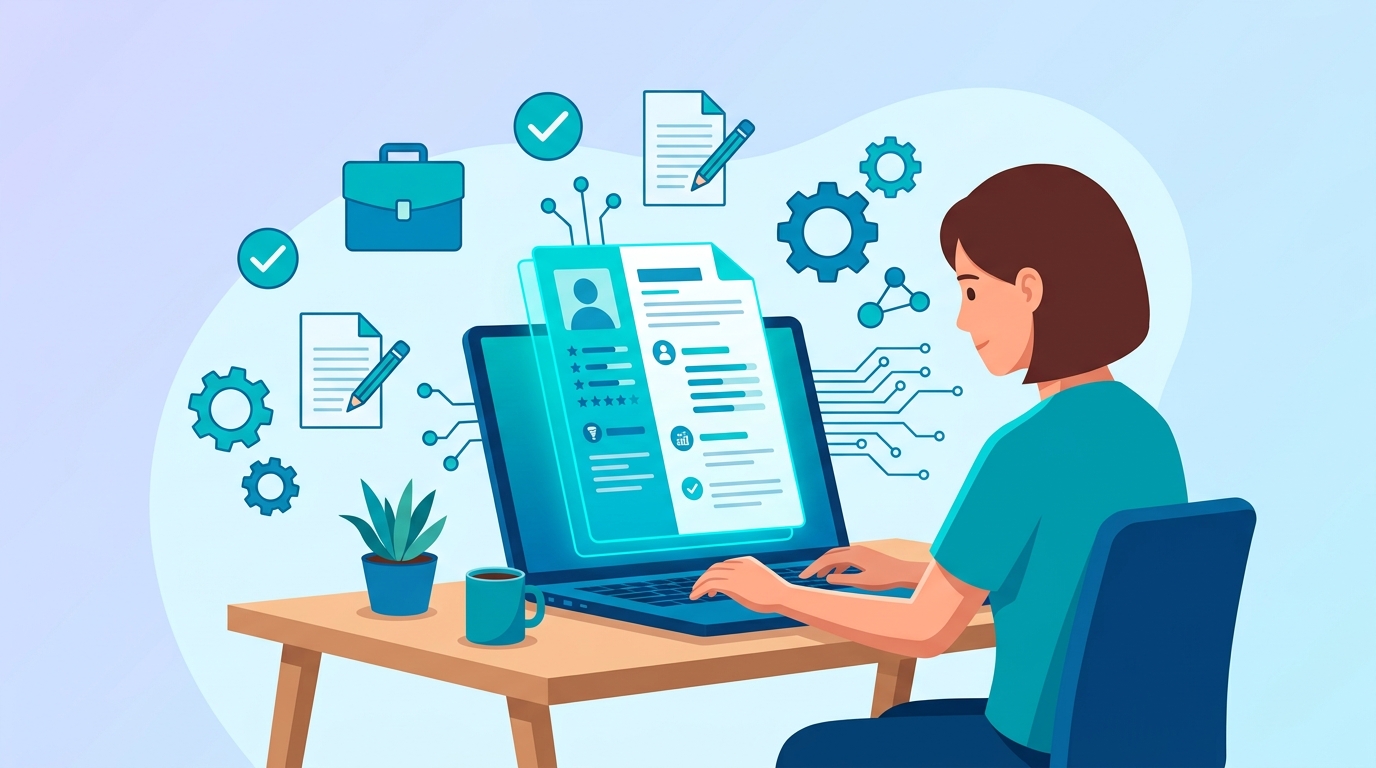
An AI resume builder is a tool that uses artificial intelligence to help you create, optimize, and tailor your resume for specific job postings. Unlike traditional resume templates, AI builders can rewrite bullet points, match keywords to job descriptions, and optimize formatting for ATS systems. This guide explains how they work, what to look for, and how to use one effectively.
You spent an hour customizing your resume for a role you're perfect for. A recruiter never saw it. An algorithm decided in 0.3 seconds that you weren't a match — and moved on to the next of 800 applicants.
That's the reality of job searching in 2026. AI is on both sides of the hiring table now. Companies use it to screen you out. You can use it to get back in. Understanding both sides is the difference between applications that disappear and applications that land interviews.
The AI Arms Race in Hiring
Here's what's happened in the last two years. Employers adopted AI screening tools faster than anyone predicted. According to a 2025 SHRM report, 92% of large companies now use some form of AI in their hiring pipeline. That's not just ATS keyword matching — it's predictive scoring, behavioral analysis, and automated ranking.
Meanwhile, candidates caught on. AI resume builders and AI job application tools exploded. The result is a feedback loop: companies add smarter filters, candidates use smarter optimization, and both sides keep escalating.
If you're still writing resumes by hand and hoping for the best, you're bringing a pen to a software fight.
How Companies Use AI to Screen You Out
Before we talk about tools for candidates, you need to understand what you're up against.
ATS Parsing and Keyword Matching
This is the first wall. Applicant Tracking Systems parse your resume into structured data, then scan for keywords from the job description. Miss the right terminology and you score a zero — even if your experience is an exact match.
The problem: job descriptions use specific phrases that may not match how you describe the same skill. "Project management" vs. "program management." "Data analysis" vs. "business intelligence." Same work, different words, different outcomes.
AI-Powered Candidate Ranking
Newer systems go beyond keywords. Tools like HireVue, Pymetrics, and Eightfold.ai use machine learning to predict candidate success based on patterns from past hires. They analyze everything from your career trajectory to how long you stayed at previous jobs.
Some of these systems are genuinely useful. Others encode the biases of whoever they were trained on. Either way, they're making decisions about your career before a human ever weighs in.
Automated Interview Screening
Video interview platforms now use AI to assess candidates on tone, word choice, and facial expressions. Your first "interview" at many companies isn't with a person at all. It's with an algorithm scoring your confidence level and communication patterns.
This matters because the rules of the game have changed. Qualifications alone don't get you through. You need to optimize for both human readers and machine readers simultaneously.
How AI Is Changing the Job Search for Candidates
Now the other side. Here's how AI job search tools are leveling the playing field.
AI Resume Builders and Writers
An AI resume builder takes your existing resume and a job description, then generates a tailored version that matches the role's specific language and requirements. The best ones don't just swap keywords — they restructure bullet points, adjust emphasis, and ensure ATS compatibility.
This solves the biggest bottleneck in any job search: customization at scale. Career coaches have always said "tailor your resume for every application." That's great advice if you're applying to three jobs. It's impossible advice if you're applying to thirty.
AI resume writers compress that tailoring process from 30-60 minutes per application to under a minute. That's not laziness — it's math.
AI Cover Letter Generators
Same principle, applied to cover letters. Feed in the job description and your background, get a draft that speaks directly to what the company is looking for. You still need to review and personalize — AI gives you the starting point, not the finish line — but it eliminates the blank-page problem.
AI Interview Preparation
Tools like InterviewGPT and various AI coaching platforms simulate interviews, provide feedback on your answers, and even prep you for company-specific questions based on Glassdoor data and job description analysis.
The quality varies wildly. But for candidates who can't afford a career coach, AI interview prep is better than no prep.
Job Matching and Application Tracking
AI-powered job boards and Chrome extensions now scan listings and match them to your profile automatically. Some will even auto-fill applications, though I'd be cautious with those — a badly auto-filled application is worse than no application.
The Ethics of AI in Hiring (Both Sides)
This is where the conversation gets uncomfortable, and it should.
The Bias Problem
AI hiring tools are trained on historical data. If a company historically hired mostly men for engineering roles, the AI learns to prefer male candidates. Amazon famously scrapped an AI recruiting tool for exactly this reason. The bias isn't theoretical — it's documented.
Newer tools claim to have addressed this with bias auditing and diverse training sets. Some have. Many haven't been independently verified. As a candidate, you're being evaluated by systems whose fairness you can't confirm.
The Authenticity Question
"Is it cheating to use an AI resume builder?" This comes up constantly, and the answer is straightforward: no, and here's why.
Using AI to tailor your resume doesn't fabricate experience. It translates your real experience into the language a specific role requires. That's what a professional resume writer does — it's just faster and more accessible.
The line is clear: using AI to present your real qualifications effectively is smart. Using AI to fabricate qualifications is fraud. The tool isn't the issue. The intent is.
The Playing Field Argument
Here's my honest take. When 92% of companies use AI to filter candidates, candidates using AI to optimize their applications isn't an arms race — it's self-defense. The power imbalance in hiring has always favored employers. AI tools for candidates reduce that gap.
If a company uses algorithmic screening to process 800 applicants for one role, you shouldn't feel guilty about using an algorithm to make sure your actual qualifications get noticed.
What to Look For in an AI Resume Builder
Not all AI resume tools are equal. Here's what separates the useful ones from the gimmicks.
| Feature | Why It Matters | Red Flag If Missing |
|---|---|---|
| Job description analysis | Identifies exact keywords and skills to match | Generic "one-size-fits-all" output |
| ATS-friendly templates | Ensures your resume passes parsing | Fancy designs that break ATS parsers |
| Original resume preservation | Tailors without losing your voice | Completely rewrites from scratch |
| Multiple version tracking | Keep tailored versions organized by company | No way to manage different versions |
| AI editing/chat | Fine-tune specific sections conversationally | Static output with no iteration |
| Free tier available | Test before committing money | Paywall before you see any results |
CVJet checks every box on this list. You upload your resume once, paste a job description, and get a tailored version in seconds. It keeps your original intact, generates ATS-friendly output, and lets you chat with AI to refine specific sections. The free tier lets you test it with real applications — no credit card, no commitment.
But regardless of which tool you choose, the features above are your checklist. Any AI resume builder worth using should hit most of them.
A Practical AI Job Search Workflow for 2026
Here's how to actually put this together into a system that works.
Step 1: Build your base resume. One comprehensive version with all your experience, skills, and accomplishments. This is your source document — it won't go to employers directly.
Step 2: Use an AI resume builder for every application. Paste the job description, let the AI tailor your base resume to match. Review the output for accuracy. This takes 2-3 minutes instead of 45.
Step 3: Generate a targeted cover letter. Use AI to draft, then spend 5 minutes personalizing with something specific about the company. Mention a recent product launch, a company value that resonates, or a mutual connection.
Step 4: Prep for interviews with AI. Once you get a callback, use AI interview tools to practice role-specific questions. Record yourself. Review. Iterate.
Step 5: Track everything. Use your AI resume builder's tracking feature (or a spreadsheet) to log which tailored version went to which company. When you get an interview, you need to remember what your resume said.
With this workflow, you can apply to 10-15 well-tailored applications per week instead of 3-4. That's not about volume — it's about removing the bottleneck between you and the jobs you're qualified for.
Will AI Replace Human Recruiters?
Short answer: no. Longer answer: AI is changing what recruiters do, not eliminating them.
The screening and filtering work that used to eat 60% of a recruiter's time is increasingly automated. But the judgment calls — culture fit, team dynamics, potential beyond the resume — those remain human decisions. AI is bad at nuance. It's bad at reading between the lines. It's bad at taking chances on unconventional candidates.
What's actually happening is that AI handles the initial funnel, and human recruiters focus on the final stages. For candidates, this means your resume needs to satisfy the algorithm, and your interview needs to satisfy the person. Two different skill sets. Both essential.
FAQ
Is using an AI resume builder cheating?
No. An AI resume builder helps you present your real experience in the language a specific job requires. It doesn't fabricate qualifications — it optimizes how you communicate them. Professional resume writers have done this for decades. AI just makes it accessible and fast.
Can employers tell if you used AI on your resume?
Most employers can't, and most don't care. What they care about is whether your qualifications match the role. A well-tailored resume that accurately represents your experience is a well-tailored resume, regardless of how you created it. The risk comes from using AI to generate content that doesn't match your actual background — that falls apart in interviews.
What's the best AI resume builder in 2026?
It depends on your needs, but look for job description analysis, ATS-friendly output, version tracking, and a free tier to test. CVJet offers all of these — you can upload your resume, paste a job description, and get a tailored version in seconds without a credit card.
How is AI changing the hiring process for employers?
Companies use AI for resume screening, candidate ranking, automated video interviews, and predictive analytics on candidate success. Over 92% of large companies now use AI somewhere in their hiring pipeline. This has made the process faster for employers but more opaque for candidates.
Should I tailor my resume for every job application?
Yes, always. Generic resumes score poorly in ATS systems because they don't match the specific keywords and phrases in each job description. An AI resume builder makes this practical by automating the tailoring process — turning a 45-minute task into a 2-minute one.
The Bottom Line
AI in hiring isn't coming — it's here, and it's on both sides. Companies use it to process more applicants faster. Candidates use it to optimize more applications faster. The candidates who understand both sides have a massive advantage.
You don't need to become an AI expert. You need a workflow that accounts for how hiring actually works in 2026. Build a strong base resume, use an AI resume builder to tailor it for each role, and prepare for interviews knowing that a human — not an algorithm — will make the final call.
Start with your next application. Paste the job description into CVJet, review the tailored output, and submit a resume that's actually optimized for the role. It's free to try, and it takes less time than reading this article did.
Related reading: How to Tailor Your Resume for Any Job | ATS-Friendly Resume Guide | Resume Writing Tips That Actually Work
Free ATS check
How do ATS rank your resume?
Drop it here and find out — the free scan shows exactly what the parser sees.
Drop your resume here
PDF or DOCX · 60 seconds · no sign-up

Founder of CVJet. Previously at Spotify, The New York Times, and Anchor FM. 14+ years building products used by millions.
Ready to build a better resume?
CVJet uses AI to tailor your resume for every job application. Upload once, generate unlimited tailored versions.
Try CVJet FreeRelated Articles
Auto Apply to Jobs with AI? Why It Now Backfires (2026)
Thinking of using AI to auto apply to jobs? Greenhouse, LinkedIn, Lever and Workday now flag mass-applied candidates. Here's the data — and what works instead.
Are ATS Resume Checkers Worth It? (Honest Review)
ATS resume checkers promise higher scores, but do they work? Honest review of top tools, their limitations, and what actually gets you past ATS.