
How to Tailor Your Resume for Every Job (Without Spending Hours)
Tailor resume to job description the right way. Step-by-step process to customize your resume for each application — plus a faster method that takes 60 seconds.
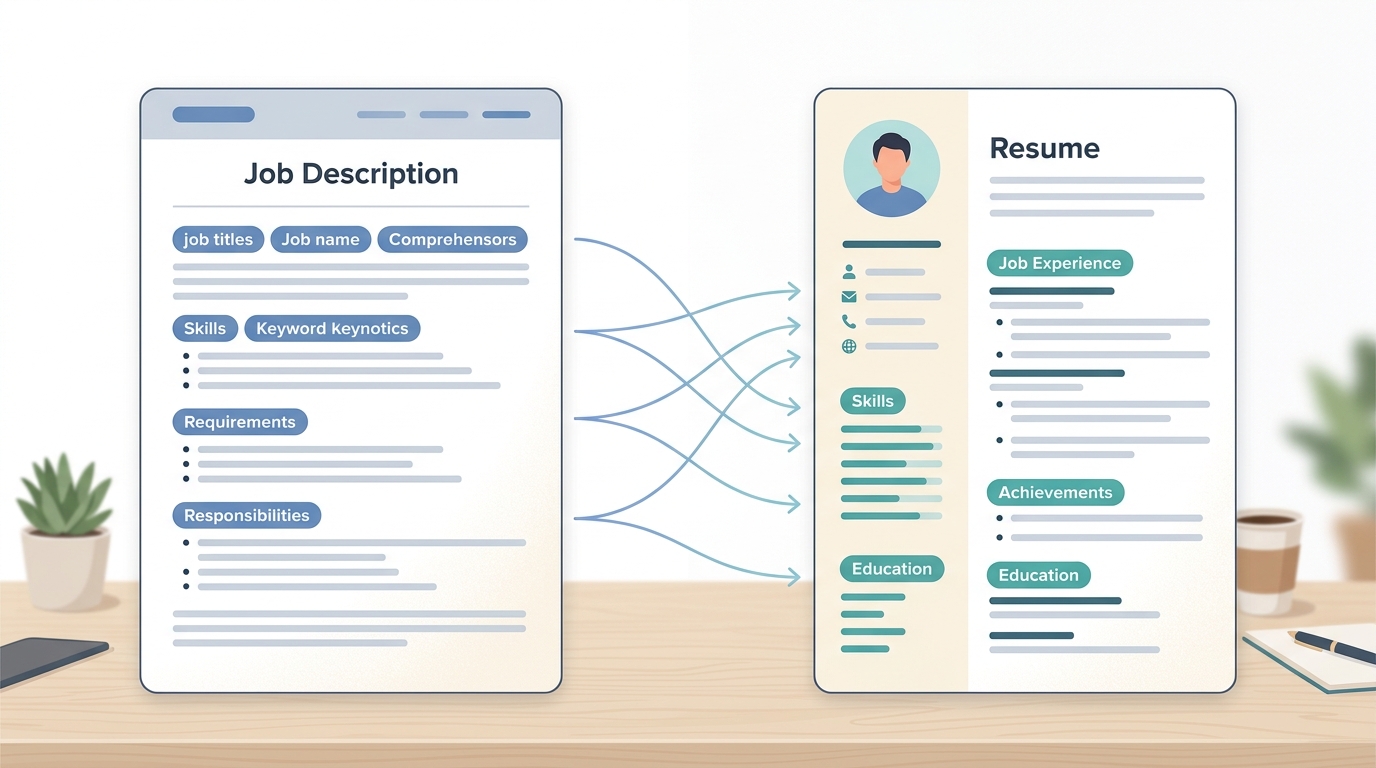
Resume tailoring is the process of customizing your resume's keywords, skills, and bullet points to match a specific job posting. A tailored resume mirrors the job description's language and priorities, making it significantly more likely to pass ATS screening and catch a recruiter's attention. Here is a step-by-step method for tailoring your resume to any job — quickly and effectively.
You sent 40 applications last month with the same resume. Maybe you tweaked the summary line once or twice. You got one callback — and it was for the role you were least excited about.
The problem isn't your experience. It's that you're sending a generic resume to jobs that aren't generic. Every posting has different priorities, different keywords, and a different picture of the ideal candidate. One resume can't speak to all of them.
Here's how to tailor your resume for every job description — and how to do it without burning your entire Sunday.
Why a Generic Resume Doesn't Work Anymore
Two things are working against you when you send the same resume everywhere.
First: ATS keyword matching. Most companies use Applicant Tracking Systems that scan your resume for specific terms from the job description. If the posting asks for "cross-functional collaboration" and your resume says "worked with multiple teams," the software might not connect the dots. You score lower. You get filtered out.
Second: recruiters spend about 6–7 seconds on an initial resume scan. They're looking for instant proof that you match this specific role. If your most relevant experience is buried in bullet point #4 under your second job, they'll never see it. A tailored resume puts the right information front and center.
Resume tailoring isn't about lying. It's about presenting the same truthful experience in the order and language that matches what the hiring manager is actually looking for.
The Manual Process: How to Tailor Resume to Job Description (Step by Step)
Step 1: Dissect the Job Description
Print it out or paste it into a doc. Now highlight three categories:
- Must-have skills — the non-negotiables (specific tools, certifications, years of experience)
- Preferred qualifications — the nice-to-haves they'll use to rank candidates
- Repeated language — phrases that appear multiple times signal what they care about most
A posting that mentions "stakeholder management" three times is telling you exactly what to emphasize.
Step 2: Identify Your Matching Experience
Go through your resume and tag every bullet point, skill, and achievement that maps to something you highlighted in Step 1. Be honest — if you've done it, it counts, even if it wasn't your primary responsibility.
Most people undersell themselves here. You may have managed vendor relationships without ever having "vendor management" on your resume. If the job description asks for it and you've done it, add it.
Step 3: Mirror the Exact Language
This is where most job seekers fall short. You need to match the terminology in the posting, not use your own synonyms.
| Job Description Says | Your Resume Says | Fix It To |
|---|---|---|
| "Data-driven decision making" | "Used analytics to guide strategy" | "Data-driven decision making for marketing strategy" |
| "Salesforce CRM" | "CRM platforms" | "Salesforce CRM" |
| "Agile methodology" | "Worked in sprints" | "Agile methodology (Scrum)" |
| "Revenue growth" | "Increased sales" | "Drove revenue growth of 34% YoY" |
The exact words matter — both for ATS matching and for the recruiter who wrote the job description and is now scanning for those same phrases.
Step 4: Reorder Your Bullet Points
Under each role, move the most relevant bullets to the top. If you're applying for a product management role, lead with product-related achievements. If the same resume goes to a project management role, lead with delivery and process wins.
This takes 5 minutes and dramatically changes how your resume reads in that 6-second scan.
Step 5: Rewrite Your Summary
Your resume summary should be a 2–3 sentence pitch tailored to the specific role. Not a generic "results-oriented professional with 8+ years of experience."
Before (generic):
Results-oriented marketing professional with 8+ years of experience across multiple industries. Skilled in strategy, analytics, and team leadership.
After (tailored for a Growth Marketing Manager role):
Growth marketing manager with 8 years of experience scaling B2B SaaS pipelines. Built and led a team of 5 that drove 140% increase in qualified leads through SEO, paid media, and lifecycle marketing programs.
The second version tells the recruiter in three seconds: "This person has done this exact job before."
The Problem: This Takes Forever
If you're applying to 10–15 jobs per week — which is a realistic pace for an active job search — the manual process above takes 20–30 minutes per application. That's 5+ hours a week just on resume tailoring.
Most people give up after the third one. They go back to the spray-and-pray approach, which is exactly why their response rates stay low.
This is the trap: you know tailoring works, but the time cost makes it unsustainable.
The Faster Way: Let AI Tailor Your Resume in Seconds
This is where tools like CVJet change the math entirely.
Instead of manually dissecting each job description and rewriting bullet points, you upload your base resume once. Then for each application, you paste the job description, and CVJet's AI generates a tailored version in about 60 seconds — matching keywords, reordering experience, and adjusting your summary to fit the specific role.
The part that matters: you stay in control. CVJet lets you set tailoring instructions that tell the AI how aggressive to be. Want it to only adjust keywords and ordering? Fine. Want a full rewrite of your summary and bullets? That works too. Every tailored version is tracked by company, so you always know which resume you sent where.
It's the difference between tailoring 3 resumes in a week (and burning out) versus tailoring 15 — each one properly customized for the role.
What to Tailor vs. What to Leave Alone
Not everything on your resume needs to change for each application. Here's a quick breakdown:
| Always Tailor | Tailor Sometimes | Leave Alone |
|---|---|---|
| Summary/objective | Job title formatting | Name and contact info |
| Skills section keywords | Bullet point order | Education (usually) |
| Top 2–3 bullet points per role | Achievements emphasis | Certifications (usually) |
| Language and terminology | Projects section | Dates and timelines |
Focus your energy on the summary and skills section. These are the highest-impact areas for both ATS matching and recruiter scanning. If you only have 5 minutes, spend them there.
Common Resume Tailoring Mistakes
Keyword stuffing. Copying every keyword from the job description and cramming them into your skills section doesn't work. ATS systems are smarter than that, and recruiters will notice. Only include skills you actually have.
Changing your job titles. Your title should match what your employer called the role. If you were a "Marketing Coordinator" and the job wants a "Marketing Manager," don't change your title. Instead, emphasize the management-level work you did in your bullet points.
Over-tailoring. If you're rewriting 90% of your resume for each application, something is off. You should be adjusting emphasis and language, not fabricating a different career history. A good tailored resume is 70–80% the same as your base version.
Ignoring the company context. A startup and a Fortune 500 company want to hear about your experience differently, even for the same role title. Startups want scrappiness and breadth. Enterprises want process and scale.
Frequently Asked Questions
Q: How much should I customize my resume for each job? A: Focus on three areas: your summary (rewrite it for the role), your skills section (match their keywords), and your top bullet points (reorder for relevance). This covers 80% of what matters. The rest of your resume can stay the same.
Q: Is it worth tailoring my resume if I'm a strong match already? A: Yes. Even qualified candidates get filtered by ATS systems that don't detect the right keywords. Tailoring ensures the software — and the recruiter — can immediately see the match. It's not about being qualified; it's about looking qualified on paper.
Q: How do I tailor my resume if I don't have all the listed qualifications? A: Focus on what you do have. Match the keywords where your experience overlaps, and use your summary to frame adjacent experience as relevant. Job descriptions are wish lists — meeting 60–70% of the requirements still makes you a strong candidate.
Q: Should I create a different resume for each industry? A: If you're targeting multiple industries, create 2–3 base resumes — one per industry. Then tailor each base version to individual job descriptions. This saves time while keeping each version focused on the right context.
Q: Can I tailor my resume too much? A: If your resume no longer sounds like you, you've gone too far. The goal is to present your real experience in the language and priority order that matches the job. Never add skills you don't have or inflate your role. Recruiters will ask you about everything on your resume.
Make Tailoring Your Default, Not Your Exception
The candidates who get interviews aren't always the most qualified. They're the ones whose resumes clearly show the match. Resume tailoring is the highest-ROI activity in any job search — the problem has always been that it takes too long.
Whether you do it manually with the steps above or use CVJet to automate the heavy lifting, the point is the same: every application deserves a resume written for that specific job.
Spending hours tailoring resumes — or worse, not tailoring at all? CVJet takes your base resume and any job description, then generates a perfectly tailored version in 60 seconds. Track every version by company. Start tailoring for free →
Internal linking suggestions
- ATS-Friendly Resume Guide — "make sure your resume passes ATS filters"
- Career Change Resume — "switching industries requires a different tailoring approach"
- Resume Writing Tips — "resume formatting best practices"
Free ATS check
How do ATS rank your resume?
Drop it here and find out — the free scan shows exactly what the parser sees.
Drop your resume here
PDF or DOCX · 60 seconds · no sign-up

Founder of CVJet. Previously at Spotify, The New York Times, and Anchor FM. 14+ years building products used by millions.
Ready to build a better resume?
CVJet uses AI to tailor your resume for every job application. Upload once, generate unlimited tailored versions.
Try CVJet FreeRelated Articles
How to Apply to 100 Jobs Efficiently (Mass Application Strategy That Works)
Apply to multiple jobs without bots or burnout. A mass application strategy for 10+ tailored resumes a day — and why auto-apply spam now backfires.
ATS-Friendly Resume: How to Get Past the Bots in 2026
Your resume is getting rejected by ATS software before humans see it. Learn the exact formatting rules, keyword strategies, and fixes to pass every time.
The Art of Resume Tailoring: A Complete Guide to the Master Resume Method
Resume tailoring made strategic. Build a Master Resume, then filter and customize for every job — manually or with AI. Complete guide inside.