
How to Improve Your Resume: The Complete 25-Point Checklist
Use this 25-point checklist to improve your resume fast. Covers format, content, ATS optimization, tailoring, and more to make your resume stand out.
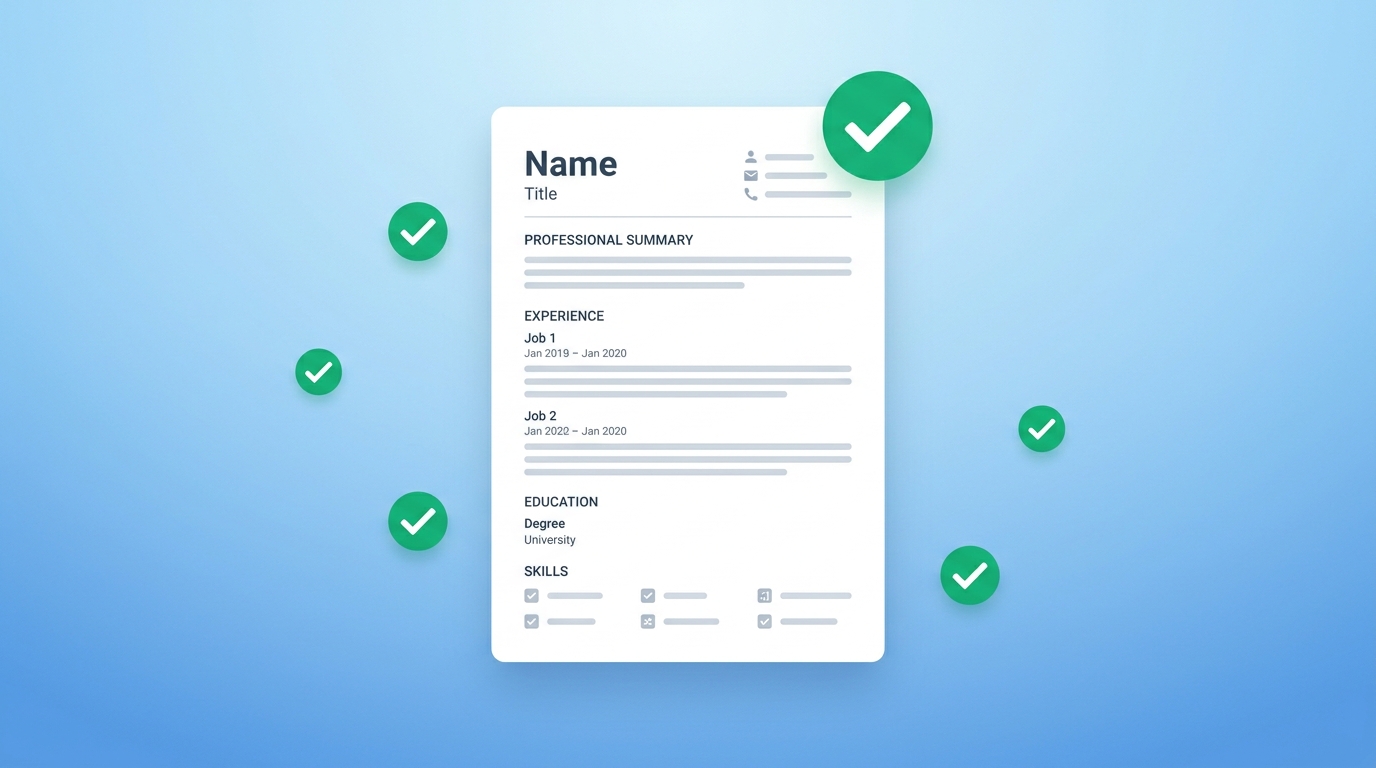
To improve your resume, focus on these high-impact changes: replace responsibility statements with quantified achievements, tailor keywords to each job description, use a clean ATS-friendly format, and cut anything that does not directly support your candidacy. The gap between a weak resume and a strong one usually comes down to 20-30 specific, fixable things. This checklist covers every area that matters.
You've sent out 50 applications and heard back from two. One was an automated rejection. The other was silence — which somehow felt worse.
The frustrating part? You're qualified for these jobs. Your resume just isn't showing it. And the gap between a weak resume and a strong one usually comes down to 20 or 30 specific, fixable things — not a total rewrite.
This checklist covers every area that matters. Run through it point by point, fix what's broken, and you'll have a resume that actually competes.
Format & Design (5 Checks)
1. Is your resume one page (or two max)? One page for under 10 years of experience. Two pages if you have more. Three-page resumes go straight to the bottom of the pile. Ruthlessly cut anything that doesn't serve the role you're targeting.
2. Are your margins between 0.5" and 1"? Too narrow and it looks cramped. Too wide and you're wasting space. Stick to 0.5"–1" on all sides. This is a surprisingly common formatting mistake that makes resumes feel off before anyone reads a word.
3. Are you using a clean, readable font? Calibri, Arial, Garamond, or Cambria at 10–12pt. No script fonts, no novelty typefaces. If your font choice draws attention to itself, it's the wrong font.
4. Is there consistent spacing throughout? Check the gaps between sections, between bullet points, and between your header and body. Inconsistent spacing signals carelessness — and hiring managers notice it subconsciously even when they can't pinpoint why a resume feels sloppy.
5. Does it pass the 6-second scan test? Print it out (or zoom out on screen). Can you identify the candidate's name, current role, key skills, and most recent company within six seconds? If not, your visual hierarchy needs work. Bold your job titles, use clear section headers, and make sure the important stuff isn't buried.
Content & Language (5 Checks)
6. Does every bullet start with a strong action verb? "Responsible for managing..." is dead weight. Replace it with built, launched, redesigned, reduced, automated, negotiated, delivered, increased. Strong verbs signal ownership. Weak verbs signal you were along for the ride.
7. Are your achievements quantified? Numbers are the fastest way to stand out. Revenue generated, costs cut, time saved, team size, percentage improvements — any number is better than no number. Even reasonable estimates beat vague descriptions like "improved efficiency."
8. Have you removed first-person pronouns? No "I managed" or "My role involved." Resume bullets are implied first person. Drop the pronouns entirely. It reads cleaner and more professional.
9. Is every bullet point under two lines? If a bullet wraps to a third line, it's too long. Split it into two bullets or tighten the language. Hiring managers skim. Dense blocks of text get skipped.
10. Have you eliminated filler words and cliches? "Results-driven professional" and "team player with excellent communication skills" say nothing specific about you. They say nothing specific about anyone. Replace vague adjectives with concrete evidence. Instead of "excellent communicator," write "Presented quarterly results to C-suite and board of directors."
Professional Summary (3 Checks)
11. Do you have a summary (not an objective)? Objective statements are outdated. A professional summary — 2 to 3 sentences — gives the reader an instant snapshot of who you are and what you bring. Skip it only if you're entry-level with limited experience.
12. Does your summary match the target role? A generic summary hurts more than it helps. It should reflect the specific type of role you're applying for, using language that mirrors the job description. A marketing manager applying for a director role needs a summary that signals director-level thinking.
13. Does it include your strongest selling point? Your summary is prime real estate. If you have a standout metric, a notable company name, or a rare skill — put it here. Lead with your best card.
Experience Section (4 Checks)
14. Are your most relevant experiences listed first within each role? Don't default to chronological order within a job. Put the bullet points most relevant to your target role at the top of each position. The bottom bullets barely get read.
15. Have you removed jobs older than 10–15 years? Unless an older role is exceptionally relevant, cut it. Outdated experience adds clutter and can trigger age bias (conscious or not). A brief "Additional Experience" line at the bottom is enough if you want to acknowledge early career work.
16. Do you show career progression? Promotions, expanding scope, increased responsibility — these matter. If you were promoted, make that visible. If your team grew under your leadership, say so. Hiring managers want to see a trajectory, not a flat line.
17. Are you using the right tense? Current job gets present tense ("Lead a team of 8"). Past jobs get past tense ("Reduced onboarding time by 40%"). Mixing tenses within the same role is a red flag for attention to detail.
Skills Section (3 Checks)
18. Is your skills section relevant to the target role? Listing Microsoft Word in 2026 wastes space. Your skills section should reflect what the job actually requires — technical tools, platforms, methodologies, certifications, and languages that are specifically mentioned or clearly implied by the posting.
19. Are hard skills separated from soft skills? Better yet, drop the soft skills entirely unless the job description specifically asks for them. Hard skills are scannable and verifiable. "Leadership" listed as a skill means nothing — show it in your experience bullets instead.
20. Have you included relevant certifications and tools? Specific platform names matter. "Data analysis" is vague. "Python, SQL, Tableau, Power BI" is scannable and keyword-rich. Same goes for certifications — PMP, AWS, Google Analytics, HubSpot — put them where both humans and software can find them.
ATS Optimization (3 Checks)
21. Are you using a single-column, ATS-friendly layout? Multi-column layouts, text boxes, headers/footers, and graphics break applicant tracking systems. The ATS reads your resume top-to-bottom, left-to-right. Keep it simple. A clean single-column format ensures nothing gets lost in parsing.
22. Does your resume include keywords from the job description? ATS software scans for keyword matches. If the posting says "project management" and you only wrote "managed projects," you might not match. Use the exact phrasing from the job description where it naturally fits. Don't stuff keywords — weave them in.
23. Is your file format correct? Submit as PDF unless the posting specifically asks for .docx. PDFs preserve formatting across every device. And name your file professionally: "FirstName-LastName-Resume.pdf" — not "resume_final_v3_UPDATED.pdf."
Tailoring (2 Checks)
24. Is your resume tailored to this specific job? This is the single highest-impact improvement most people skip. A tailored resume matches the language, priorities, and requirements of the specific posting. It's the difference between looking like a fit and looking like a mass applicant.
Doing this manually for every application is exhausting — which is why most people don't. CVJet handles it automatically. Upload your resume once, paste in the job description, and it generates a tailored version in seconds. It matches your actual experience to what the role requires, uses ATS-friendly templates, and lets you track every version by company.
25. Have you had someone else review it? Fresh eyes catch what yours can't — typos, unclear phrasing, missing context. Ask a friend in your industry, a mentor, or use CVJet's AI chat editor to get line-by-line feedback on specific sections. Sometimes one outside perspective is worth more than hours of self-editing.
How to Use This Checklist
Don't try to fix everything in one sitting. Pick the category where your resume is weakest and start there.
For most people, the biggest wins come from three areas: quantifying achievements (checks 7 and 16), ATS optimization (checks 21–23), and tailoring (check 24). If you only have 30 minutes, focus there.
If you want to shortcut the process, CVJet can handle several of these automatically — particularly the tailoring, keyword matching, and formatting checks. Upload your resume, paste a job description, and see how an optimized version compares to what you have now. It's free to start, no credit card required.
FAQ
How often should I update my resume?
Every time you hit a new milestone — a promotion, a completed project with measurable results, a new certification. At minimum, update it every six months even if you're not actively job hunting. Waiting until you need it means you'll forget half your accomplishments.
Can a resume be too short?
Yes. If you have 5+ years of experience and your resume is half a page, you're underselling yourself. One full page is the minimum for mid-career professionals. The goal isn't brevity for its own sake — it's density of relevant information.
What's the single fastest way to improve a weak resume?
Add numbers to your bullet points. Most resumes are vague descriptions of responsibilities. The moment you add specific metrics — revenue, percentages, team sizes, timelines — your resume goes from forgettable to credible. It takes 20 minutes and changes everything.
Should I include a photo on my resume?
In the US, no. Most ATS systems can't parse them, and they introduce unconscious bias into the screening process. In some European and Asian markets, photos are expected — know the norms for your target market.
Is it worth paying for a professional resume writer?
It depends on the writer. A good one brings industry knowledge and an outside perspective. But many just reformat what you give them with fancier language. Before spending $200–$500, try improving your resume with a structured checklist like this one — you may find the issues were more fixable than you thought.
Make It Happen
Your resume isn't a biography. It's a marketing document with one job: get you the interview. Run through this checklist, fix the gaps, and you'll have something that actually represents what you can do.
If you want to move faster, try CVJet free — paste in a job description and see your resume tailored, optimized, and ATS-ready in seconds.
Related reading:
Free ATS check
How do ATS rank your resume?
Drop it here and find out — the free scan shows exactly what the parser sees.
Drop your resume here
PDF or DOCX · 60 seconds · no sign-up

Founder of CVJet. Previously at Spotify, The New York Times, and Anchor FM. 14+ years building products used by millions.
Ready to build a better resume?
CVJet uses AI to tailor your resume for every job application. Upload once, generate unlimited tailored versions.
Try CVJet FreeRelated Articles
How to Apply to 100 Jobs Efficiently (Mass Application Strategy That Works)
Apply to multiple jobs without bots or burnout. A mass application strategy for 10+ tailored resumes a day — and why auto-apply spam now backfires.
ATS-Friendly Resume: How to Get Past the Bots in 2026
Your resume is getting rejected by ATS software before humans see it. Learn the exact formatting rules, keyword strategies, and fixes to pass every time.
The Art of Resume Tailoring: A Complete Guide to the Master Resume Method
Resume tailoring made strategic. Build a Master Resume, then filter and customize for every job — manually or with AI. Complete guide inside.