
Should You Have Multiple Versions of Your Resume? (Yes — Here's Why)
Multiple resume versions help you land more interviews. Learn when you need different resumes and how the Master Resume approach makes it easy.
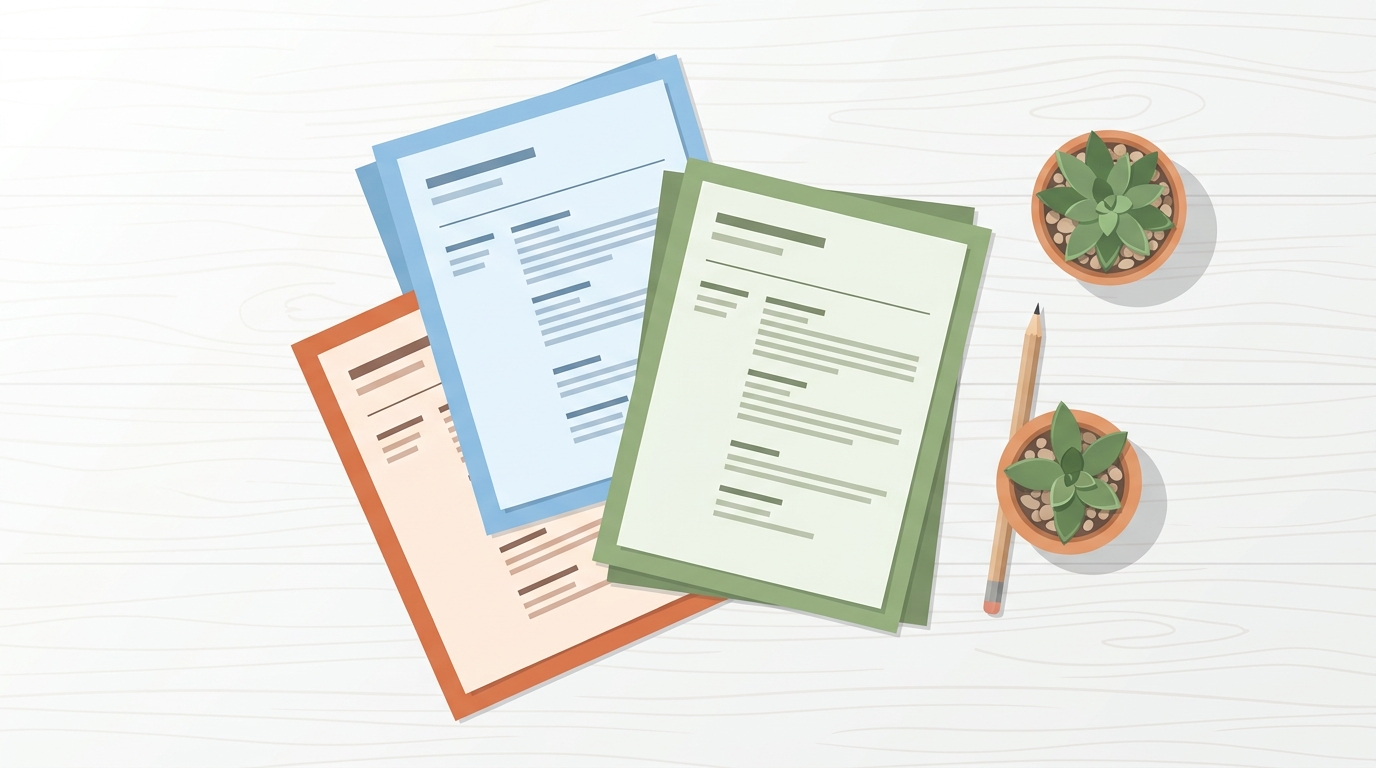
Yes, you should have multiple resume versions — typically one master resume and 2-4 role-targeted variants that emphasize different skills, keywords, and experience for different job types. A single resume cannot speak to fundamentally different roles. This guide explains the Master Resume method: a structured approach to managing multiple versions without chaos.
You're applying to project management roles at a tech startup and operations roles at a Fortune 500 — with the exact same resume. One emphasizes agility and cross-functional ownership. The other wants process optimization and scale. Your single resume can't speak both languages at once.
And that's why most people get ghosted by at least half the jobs they apply to.
The short answer to "should I have multiple resume versions?" is yes, absolutely. But not in the chaotic, save-as-v7-final-FINAL way you might be imagining. There's a method to it.
Why One Resume Isn't Enough
Every job posting is a wishlist written by a specific team with specific pain points. Even two postings with the same title can prioritize completely different things.
A "Marketing Manager" at a B2B SaaS company wants demand gen metrics, SQL skills, and ABM experience. A "Marketing Manager" at a consumer brand wants campaign creative, influencer partnerships, and brand storytelling. Same title. Different universe.
When you send one resume to both, you're hoping the reader will connect the dots for you. They won't. Recruiters scan for 6-7 seconds. If your most relevant experience isn't immediately obvious, you're out.
And then there's the ATS problem. Applicant Tracking Systems score your resume based on keyword matches to the job description. Different roles use different terminology — even for similar work. One version can't contain every possible keyword without looking like a spam document.
Three Situations Where You Need Multiple Resumes for Different Jobs
Not everyone needs five resumes sitting in a folder. But if any of these apply to you, different resume versions aren't optional — they're necessary.
1. You're Targeting Different Roles
This is the most common scenario. Maybe you're a product designer who also qualifies for UX research roles. Or a software engineer exploring both IC and management tracks.
Each role type needs its own resume because the hierarchy of information changes. For a UX research role, your user studies and insights should lead. For a product design role, your shipped features and design systems matter more. Same career, different story.
2. You're Applying Across Industries
A data analyst moving from healthcare to fintech needs to reframe almost everything. Healthcare experience should emphasize regulatory compliance, patient outcome metrics, and HIPAA-aware data practices. For fintech, you'd highlight risk modeling, transaction data, and speed of delivery.
The skills transfer. The framing doesn't. Your resume variations need to translate your experience into the language each industry actually uses.
3. You're Targeting Different Company Sizes
Startups and enterprises hire differently because they need different things.
A startup wants to see that you can wear multiple hats, move fast, and build from zero. An enterprise wants to see that you can operate within complex systems, influence stakeholders, and drive results at scale.
If your resume leads with "built a team from scratch" when applying to a 50,000-person company, you're signaling that you might not thrive in their environment — even if you absolutely would.
The Master Resume Approach (Your Sanity Saver)
Having multiple resume versions doesn't mean maintaining five separate documents from scratch. That's a nightmare and a recipe for inconsistencies.
Instead, use the Master Resume method:
Step 1: Build one comprehensive document. This is your master file. It includes every role, every achievement, every skill, every certification you've ever had. It's not meant to be sent to anyone — it's your complete career inventory. Think 3-5 pages, no editing for length.
Step 2: Tag each item by relevance. Go through your master resume and note which items are relevant to which types of roles or industries. Your project management bullets might be tagged "PM + Ops." Your data analysis work might be tagged "Analytics + Strategy."
Step 3: Create role-specific versions by selecting from your master. For each target role, pull the most relevant items and arrange them with the highest-impact content first. Cut everything that doesn't serve this particular application. Aim for one page (two if you're senior).
Step 4: Customize the language. Even after selecting the right content, mirror the terminology from each job description. If they say "stakeholder alignment" and your master resume says "cross-team coordination," update the language for that version.
This way, you're never starting from zero. You're curating from a complete inventory.
Making Resume Variations Practical (Not Painful)
The Master Resume approach works. But let's be honest — Step 3 and Step 4 are still time-consuming when you're applying to 10+ jobs per week.
This is exactly the kind of repetitive, high-stakes work that benefits from smart tooling. CVJet was designed around this workflow: you upload your base resume once, paste in a job description, and get a tailored version in seconds. It handles the keyword matching, content reordering, and formatting so each version is ATS-optimized without manual effort.
You still review and approve everything — the AI does the heavy lifting, not the decision-making. And since CVJet tracks every version by company name, you won't end up in the "which-resume-did-I-send-them" spiral three weeks later when you get the interview call.
How Many Resume Versions Do You Actually Need?
A reasonable starting point:
- 2-3 base versions if you're targeting different role types or industries
- Light tailoring per application on top of those base versions (adjusting keywords, reordering bullets, tweaking the summary)
You don't need 47 resumes. You need a small number of well-crafted templates that you can quickly adapt. The base versions handle the big structural differences. The per-application tweaks handle the details.
Most people who try to manage this manually either burn out and start sending the same resume everywhere, or spend so much time tailoring that they apply to fewer jobs. Neither is a good outcome.
Common Mistakes With Multiple Resume Versions
Changing your job titles or dates between versions. Never do this. Your resume variations should differ in emphasis, language, and content selection — not in factual information. Background checks exist.
Making versions so different they seem like different people. A recruiter who sees your LinkedIn and your resume should recognize the same professional. Consistency in your career narrative matters even across different resume versions.
Forgetting which version you sent where. This sounds minor until you're in an interview referencing a project that isn't on the resume they're holding. Use a tracking system — even a simple spreadsheet works, though tools like CVJet handle this automatically.
FAQ
Is it OK to have multiple versions of your resume?
Yes — it's not just OK, it's recommended. Recruiters and career coaches consistently advise having different resume versions for different job types. As long as all versions are truthful and consistent in your career facts, tailoring your emphasis and language for each application is a best practice, not a red flag.
How many versions of my resume should I have?
Most job seekers benefit from 2-3 base versions aligned to different role types or industries, plus light customization for individual applications. You don't need a unique resume for every single job, but you shouldn't use one generic version for everything either.
Should I tailor my resume for every job application?
At minimum, you should adjust keywords and your professional summary for each application. Full restructuring isn't always necessary if you already have a base version that fits the role type. The goal is making sure each resume clearly reflects what that specific employer is looking for.
How do I keep track of different resume versions?
Use a naming convention like "Resume_PM_Startup_CompanyName" and maintain a simple log of which version went where. Spreadsheets work. Resume management tools like CVJet automatically track every tailored version by company, which eliminates the manual tracking entirely.
Does having multiple resumes hurt my personal brand?
Not at all. Your personal brand is your overall career story — your resume is just one expression of it, optimized for a specific audience. Think of it like how you'd describe your job differently to a technical interviewer versus a hiring manager. Same truth, different angle.
The Bottom Line
Having multiple resume versions isn't about deception or extra busywork. It's about giving each employer the clearest possible picture of why you're right for their specific role.
Start with a master resume that captures everything. Build 2-3 targeted base versions. Then tailor lightly for each application. If the manual process feels like too much, try CVJet for free — paste a job description and get a tailored version in under a minute.
The jobs you want are specific about what they need. Your resume should be equally specific about what you offer.
Related reading:
Free ATS check
How do ATS rank your resume?
Drop it here and find out — the free scan shows exactly what the parser sees.
Drop your resume here
PDF or DOCX · 60 seconds · no sign-up

Founder of CVJet. Previously at Spotify, The New York Times, and Anchor FM. 14+ years building products used by millions.
Ready to build a better resume?
CVJet uses AI to tailor your resume for every job application. Upload once, generate unlimited tailored versions.
Try CVJet FreeRelated Articles
How to Apply to 100 Jobs Efficiently (Mass Application Strategy That Works)
Apply to multiple jobs without bots or burnout. A mass application strategy for 10+ tailored resumes a day — and why auto-apply spam now backfires.
ATS-Friendly Resume: How to Get Past the Bots in 2026
Your resume is getting rejected by ATS software before humans see it. Learn the exact formatting rules, keyword strategies, and fixes to pass every time.
The Art of Resume Tailoring: A Complete Guide to the Master Resume Method
Resume tailoring made strategic. Build a Master Resume, then filter and customize for every job — manually or with AI. Complete guide inside.