
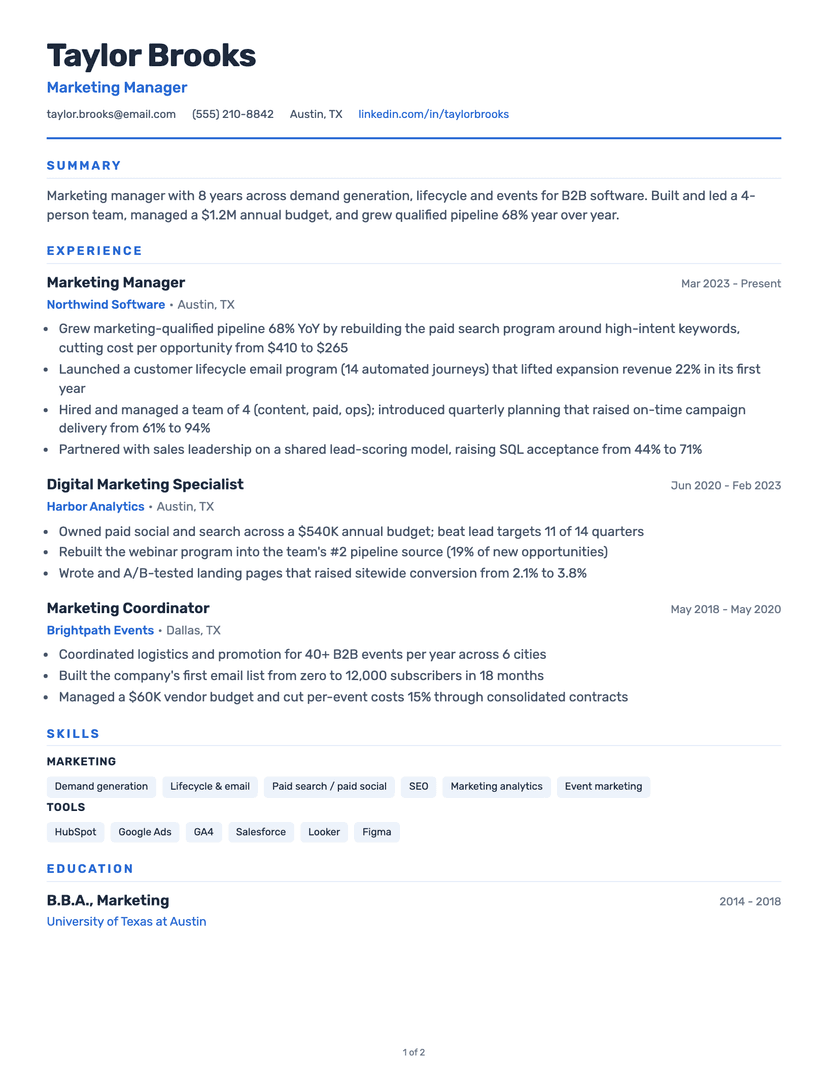
See this medical assistant resume in another design
Browse allWhy this resume works
- 01
Certified Clinical Medical Assistant (CCMA), National Healthcareer Association (NHA), active through 2027
Postings list CMA, RMA, CCMA and NCMA as alternatives. Naming the credential, the issuer and the status lets a recruiter tick the box in one look.
- 02
Room 22 to 26 patients a day for a 3-provider cardiology clinic: vitals, medication reconciliation and allergy review, documented in Epic
Patients a day and the number of providers tell a practice manager whether you can keep pace with their schedule, and the EHR is named.
- 03
Run 15 to 20 resting 12-lead EKGs a day and apply Holter monitors, flagging abnormal tracings to the provider before the visit
Specialty clinics hire for specific procedures. A daily count shows the skill is current, and the flag shows judgment.
- 04
Covered front and back office for a 2-physician practice: check-in, insurance eligibility, rooming and checkout for 20+ patients a day
Smaller practices want one person who can do both. Postings we read put insurance verification and prior authorizations in the MA job.
What recruiters look for in a medical assistant resume
- A current credential with its issuer. Postings we read accepted CMA (AAMA), RMA (AMT), CCMA (NHA) or NCMA; some required one, others only preferred it
- BLS, with American Heart Association named. One pediatric posting accepted AHA BLS only; another allowed it within one month of hire
- Back-office tasks by name: vitals, rooming, injections, specimen collection, EKG setup and assisting with minor procedures
- Front-office work if you did it: scheduling, insurance verification, prior authorizations and answering patient messages
- Your EHR by name. One posting required a year of Epic; another named KP HealthConnect
- Months in the job and the setting: postings asked for 6 months to 2 years, often in ambulatory care or a named specialty
Skills for a medical assistant resume
- Certifications
- CMA (AAMA)RMA (AMT)CCMA (NHA)NCMA (NCCT)Basic Life Support (BLS)Certified Phlebotomy Technician (CPT)
- Back office (clinical)
- Vital signsPatient intakeMedication administrationInjections and immunizationsSpecimen collectionVenipunctureElectrocardiogram (EKG)Wound careInstrument sterilizationAssisting with minor procedures
- Front office (administrative)
- Appointment schedulingInsurance verificationPrior authorizationReferral coordinationPatient messagesMedical terminology
- Systems
- Electronic medical records (EMR)EpicKP HealthConnectathenahealth
Turn clinic duties into results
Before
Assisted physicians with patient care.
After
Room 22 to 26 patients a day for a 3-provider cardiology clinic: vitals, medication reconciliation and allergy review, documented in Epic
Volume, team size and the actual tasks.
Before
Performed EKGs.
After
Run 15 to 20 resting 12-lead EKGs a day and apply Holter monitors, flagging abnormal tracings to the provider before the visit
A daily count plus what you do with the result.
Before
Drew blood and gave shots.
After
Performed 30 to 40 venipunctures a week, plus immunizations and point-of-care tests (rapid strep, influenza, A1C)
Weekly volume and the named tests.
Before
Handled insurance and referrals.
After
Submit about 35 prior authorizations and referrals a week; average turnaround is 2 days against the clinic's 5-day target
Count, speed and the clinic's own target.
Action verbs for a medical assistant resume
- Roomed
- Recorded
- Reconciled
- Administered
- Injected
- Collected
- Performed
- Assisted
- Sterilized
- Stocked
- Scheduled
- Verified
- Submitted
- Routed
- Documented
- Trained
Keywords from medical assistant postings
Terms that recurred in the postings we read. Use the exact wording of the posting you apply to.
- CMA (AAMA)
- RMA (AMT)
- CCMA (NHA)
- Basic Life Support (BLS)
- Vital signs
- Rooming
- Medication administration
- Immunizations
- Specimen collection
- Electrocardiogram (EKG)
- Minor procedures
- Electronic medical records (EMR)
- Epic
- Prior authorization
- Insurance verification
- Appointment scheduling
- Ambulatory care
- Medical terminology
Common medical assistant resume mistakes
Writing "certified" with no credential or issuer
Write the credential and the body: "CCMA, National Healthcareer Association, active". The recruiter can verify it, and it still matches a posting that names a different credential as an alternative.
Leaving front-office work off a clinical resume
Postings we read mixed both halves. If you verified insurance or ran prior authorizations, give it a bullet with a weekly count.
Dropping BLS because the card lapsed
Book the class and list it with the date: "BLS, American Heart Association, class scheduled Jan 2027". One posting gave a month after hire; another accepted AHA only, so name the issuer.
Writing "EMR systems" instead of the system
Name it: Epic, athenahealth, eClinicalWorks. One posting we read required a year of Epic, and a clinic on your system saves weeks of training.
New graduate: certification pending, externship as experience
If you have not tested yet, write the exam and the month: "CMA (AAMA) exam scheduled Feb 2027". The AAMA lets students register once classroom coursework is complete, before the practicum ends, and graduates can apply within 12 months.
Put the externship under Experience with the site, specialty, hours and what you did each day. AMT's education route for the RMA requires at least 160 externship hours, and one health system posting we read accepted its own externship in place of six months of experience.
Frequently asked questions
What is the difference between CMA, RMA and CCMA?+
They are national certifications from different bodies. The CMA comes from the American Association of Medical Assistants and requires a CAAHEP- or ABHES-accredited program. The RMA comes from American Medical Technologists and the CCMA from the National Healthcareer Association. Most postings we read accepted any of them.
Do I need to be certified to work as a medical assistant?+
Not everywhere. The Bureau of Labor Statistics says some states require graduation from an accredited program or certification, and employers may prefer it where it is not required. Of the postings we read, one health system posting asked for no certification and others required or preferred one.
Can I get certified with work experience instead of school?+
For the RMA, yes. AMT's work-experience route asks for 3 years as a medical assistant within the past 7, covering both clinical and administrative duties. The CMA (AAMA) requires an accredited program instead.
How do I keep my certification current on my resume?+
Show the status or end date. The CMA (AAMA) is recertified every 60 months, by 60 continuing education units or by retaking the exam. The CCMA is renewed every 2 years. An expired credential reads worse than a pending one, so renew before you apply.
How do I write a medical assistant resume with no experience?+
Lead with the credential or the exam date, then treat the externship as your first job: site, specialty, hours and daily volume. Add any front-desk, retail or reception work, with numbers such as customers a shift, since postings value scheduling and patient contact.
Sources
- BLS Occupational Outlook Handbook: Medical Assistants · read 2026-11-14
- AAMA: CMA (AAMA) exam eligibility · read 2026-11-14
- AAMA: Recertify your CMA (AAMA) certification · read 2026-11-14
- American Medical Technologists: Registered Medical Assistant (RMA) eligibility · read 2026-11-14
- DoD Credentialing Opportunities On-Line: Certified Clinical Medical Assistant (NHA) · read 2026-11-14
Resume examples for related roles
Already have a resume? See exactly what an ATS parses out of it.
Run the free ATS checker